Alternate Mondays 8pm to 10pm
Contact us at:
harrow dot aikido at gmail dot com
About Aikido
Welcome to Harrow's premier Aikido club.
About Aikido Training
Aikido is a modern Japanese martial art for self defence against single or multiple attackers. We practise on mats, usually in pairs, and learn to neutralise strikes and grabs by applying throws and pins.
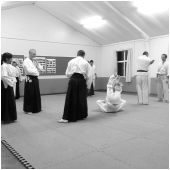
Every class begins with a warm up and basic movements and exercises, such as stretching, practicing breakfalls and posture breaking movements. The first thing that new students are taught is how to fall and roll safely.
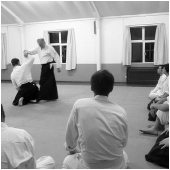
The usual training fornat is for the receiver of the technique (known as the 'uke') to initiate a specific attack against the defender (known as the 'tori'). The tori then defends against the attack using a specified Aikido technique.
Both partners are therefore learning aikido principles by blending with the attack and adapting it for the technique.
In the case of the 'uke' keeping balanced and looking for vulnerabilities
(e.g., an exposed side), whilst the tori uses positioning and timing to keep the uke off-balance and vulnerable.
This helps to achieve a controlled relaxation and flexibility.
There is absolutely no emphasis placed on building up physical strength, but instead on the use of coordinated whole-body movement and balance.
Students do have to deliver various sorts of attacks, but these are not studied in any depth. ‘Genuine’ attacks, be it a strong strike or an immobilizing grab, are all that's needed to learn the application of technique.
Once the basic techniques have been learned, students move towards freestyle defense with multiple ukes, and progress to techniques against weapons. The freestyle practice exercises the students ability to perform techniques by intuitive reaction in an unstructured environment. Strategic choice of techniques, based upon how they reposition the student relative to the other attackers, is also improved.
Aikido training focuses the ability to relax the mind and body even under the stress of dangerous situations. This is necessary to allow the practitioner to perform the bold ‘enter and blend’ movements that underlie Aikido techniques, so that an attack is countered with directness and confidence.
Aikido practitioners aka aikidoka, progress through a series of kyu grades, followed by a series of dan grades, which are awarded after satisfactory completion of formal tests. The requirements vary between differing styles, so a particular rank in one associattion is not always comparable or interchangeable with that rank in another.
The uniform worn for practicing Aikido (aikidogi) is similar to the training uniform (keikogi) used in most other modern martial arts; simple trousers and a wraparound jacket, usually white. Both thick ‘judo-style’, and thin ‘karate-style’ cotton tops are used. Aikido-specific tops are also available with shorter sleeves, which reach to just below the elbow.
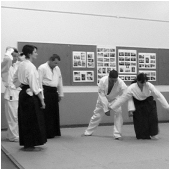
A pair of wide, pleated, black trousers called a hakama may also be worn. In many styles its use is reserved for the black belt ranks, whilst others allow all practitioners or female practitioners to wear a hakama regardless of rank. Here at Harrow Aikido Club, a hakama may be worn after achieving the second grade - 4th Kyu or Orange belt.
An interesting point to note about Aikido training, is that the techniques can be practised fully since they do not require injury to the training partner. This differs to some other martial arts where the techniques must be simulated in order to avoid injuring training partners.